Showing posts with label mapping. Show all posts

Monday, March 4, 2013

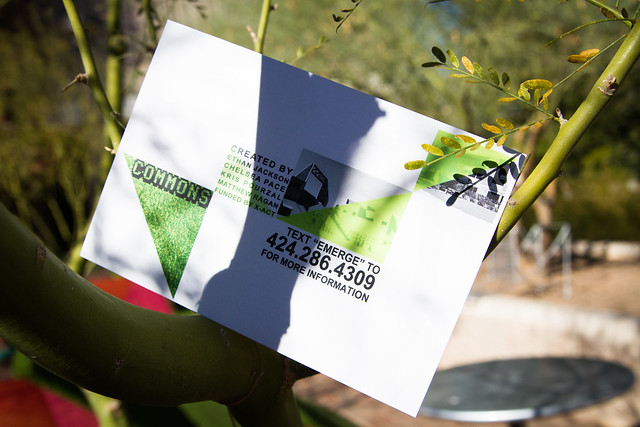
Emerge | Commons

This year I was fortunate to have the opportunity to contribute to the performance schedule of ASU's conference about art, science, and the future. This is the second year that Emerge has happened at ASU, with the final night being  a culminating festival of performance and art. In the Fall of 2012 I worked with a group of artists to put together a proposal for creating a performance in Neeb Plaza on ASU's campus. This courtyard that sits nestled between Neeb hall, the Art building, and Design houses a new student generated installation called X-Space each year. Looking to solicite the creation of new works, the Herberger institute put out a call for artists interested in organizing a performance that occurs in X-Space. Called X-Act, applicants were asked to consider hw they would use the space and engage the campus. Early in January my team found out that we our proposal, Commons, was selected. One of the stipulations of the grant was that we would have a showing during the final showcase of Emerge. With this news in mind, our team started the process of creating the installation we had proposed. 


One of the elements that our team was committed to realizing was finding a way to integrate projection into the performance on this very geometrically interesting space. I started by measuring the physical dimensions of the space in order to determine the distance required for the projectors that I had available for this project. Using a bit of math one can calculate the throw distance of a projector. Alternatively it's also easy to use Projector Central's Projection Calculator in order to lock down approximate distances that you might need. With the numbers in front of me I was able to start making a plan about potential projector placement, as well as my options for the performance given the constraint of the size of image that I could create. With the limitations of distance roughly mapped out I headed to the space after dark to do some initial tests. The hard truth about the amount of ambient light in the plaza, and the limits of the InFocus projectors meant that I needed to shy away from projecting large in favor of being brighter. The compromise of brightness and size was to map the front surfaces of X-Space. To accomplish this, I needed to connect two projectors with a Matrox TripleHead. This piece of equipment allows for multi-monitor work where the computer sees the two projectors as though they were a single canvas. 


It took about 4 hours to pull of the necessary equipment, install, and focus the projectors. Once I had the projectors up and in place I was finally able to start mapping the surfaces. I had decided early on that I was going to use a piece of software called Modul8 to control my media playback. Modul8 is a VJ software software package that's robust and easy to use. Unlike other pieces of software, Modul8 is more like an instrument than an autonomous agent that can run independently. While there are a bunch of functions that you can automate inside of the software, it's largely built around the idea of live-mixing the media that you're using. In terms of automation, Modul8 allows the operator to use audio input to control a number of playback triggers. For this project the team used a track by DJ Earworm for audio, largely motivated by the desires of the group recruited for the dance performance. One of the additional benefits of Modul8 is it's ability to send Syphon out media. This means that this piece of playback software can be easily integrated with the mapping tool MadMapper. Here it was as important to know what media system (projectors, hardware, and software) I was using, as the conceptual idea around the performance itself. 

Media Diagram

After getting the hardware installed I started mappping the surfaces of X-Space, creating individual quads and masks for each plane. All in all it took me about three hours to create the maps and masks for the architecture. At this point I was finally able to start experimenting with what kind of media I wanted to use, and how I wanted to arrange it in the space. All in all I budgeted about 16 hours to get this project up and running. Implementing the plan I had created ended up taking about 16.5 hours. This meant that I had one night where I worked on this installation until 3:15 AM, and another night where I was working until just before midnight.  We also had a rather unfortunate miscommunication with the Emerge planning staff about this installation, and the importance of having a security guard available to monitor the site over night. Installation started on Thursday evening, and each of the team members took a shift over night to monitor the outdoor equipment. Luckily we ended up with security for the second night, and didn't have to pull any more all-nighters. 


Finally, while this project looked beautiful on the empty space, there was a miscommunication about audience placement and how stanchions were going to be used at the actual event. While the team had discussed the importance of roping off the performance space, that request was lost on the actual event planners. Consequently the audience largely obstructed the projections as they used the actual stage space as seating. Additionally, the space was filled with stage lighting and projectors rented for another performance which only served to wash-out Commons media, and distract audience members. While this was certainly not a failure, it did leave a lot to be desired given the time, planning, and sleepless nights that implementation required. It's just another lessoned learned, even if learned the hard way.


Tools Used
Programming and Playback- Modul8
Mapping - MadMapper
Multi-Monitor Control - Matrox TripleHead2Go Digital
Video Editing - Adobe After Effects
Image Editing - Adobe Photoshop 
Documentation - iPhone 4S, Canon 7D
Editing Documentation - Adobe PremiereAdobe After Effects


Commons
X-Act Proposal

Ethan Jackson | MSD New Production Innovation | College of Design
Chelsea Pace | MFA Performance | School of Theatre and Film
Kris Pourzal | MFA Dance / School of Dance
Matthew Ragan | MFA Interdisciplinary Digital Media and Performance | School of Theatre and Film & Arts, Media + Engineering

Activating a campus of this size is a challenge. With so many majors across so many schools, it would be impossible to activate the entirety of the campus with only arts students, or any small group of students for that matter. We propose Commons.

We are excited to propose a 100 person ensemble comprised mostly of non-performers. This ensemble would be assembled by the team over the next several months by contacting graduate students and undergraduates from various departments and schools across ASU, both inside and outside of the Herberger Institute. The inattention is that the sample of students would be a proportional and accurate representation of the population of the Tempe Campus student body.

This project is ambitions and we are not ignorant of the challenges presented by gathering an ensemble of this size. The difficulty is doubled with you consider that we intend to bring mostly non-performers into the ensemble. The groundwork fro the process of contacting graduates students to enlist undergraduates from across campus is already being laid through contacts in Preparing Future Faculty and the Graduate and Professional Student Associate. 

The piece inherently activates the campus by reaching out across so many disciplines and getting people together, working together, and making art. The choreography will be created by the team and also crowd sourced from the assembled ensemble and the music (potentially) will b a remix of music surged by the group.

Not to be confused with a flash-mob, Commons will be a collaboration with all 100 performers. Created as an ensemble, the performs will truly have ownership over the piece and more than just regurgitating choreography, the piece will be brought to life by the population of Arizona State University.

The piece will use the X-Space, the cement plaza to the south, and the wall of the building west of the X-Space. When the audience enters the cement courtyard immediately south of the space, the floor will be lit with interactive projections triggered by the movement of the crowd. After the audience has gathered, the ensembles will emerge from the X-Space installation and begin a choreographed sequence. Theatrical lights, projections, and sound will be utilized to create an immersive environment for both the audience and the performers.

As the choreography builds and more performers are added, a live video feed will begin and will be projected several stories high onto the textured wall of the building to the west of the courtyard. THe projection will be live video of the performance and of the the audience.

The piece is approximately 30 minutes in duration and would allow for various groups of students who are professional distanced from performing to express themselves in a performative and expressive way. The piece ends with the performers exiting through the crowd and out onto campus where they will continue to perform choreography for 10 minutes in a space that is significant to their experience at ASU.

Rather than making something with HIDA students that only HIDA students see and perform in, Commons will truly activate the campus to come together, make something, and take it out into their communities across campus. 

Thursday, January 31, 2013

Sparrow Song | Drawing with Light


In January I was a contributing digital artist to a production called Sparrow Song. The production focused on the creation of an interactive art-installation / theatrical environment. The production begins with a short performance where audience members are introduced to various interactive elements in the playing space. After the short "play" the audience is invited to explore and play in the art-installation themselves. 

Mad-Mapper is a very powerful tool for quickly mapping spaces, but it's not always the best tool for theatrical play-back. For theatrical productions artists start by creating a series of masks as tools to isolate or highlight scenic elements with projector light. These masks are in many ways analogous to mattes used in photography or video editing. In order to isolate media in the space, each element that had a unique mediated element required its own mask. Further, each projector out-put also needed to be masked in order to avoid spill or bleed between projectors.

One of the effects that I've used in two productions now is where lines appear to draw-in over time in a video. This effect is fairly easy to generate in After Effects, and I wanted to take a quick moment to detail how it actually works. This process can start many ways. For Sparrow song it started by connecting a laptop directly to the projectors being used, and using photoshop to map light directly onto the set. You can see in the photo to the right that each surface that's intended to be a building has some kind of drawn on look. In photoshop each of these buildings exists as an independent layer. This makes it easy to isolate effects or changes to individual buildings in the animation process.


Here's a quick tutorial about how I animated the layers to create the desired effect:


Now that I've done this several times it finally feels like a fairly straightforward process - even if it can be a rather time consuming one.

Here's an example of what the rendered video looks like to the playback system.


Making the asset itself is only a part of the process. After you have a video rendered, the next step is to integrate that into your playback system so that it can be controlled during a performance. For Sparrow Song, the playback engine was Isadora, made by Troikatronix. Here's a quick video that covers movie playback in this system.


Here's an album of documentation photos from the closing show.


Tools Used
Digital Drawing Input - Wacom intuos4
Mapping and Artwork - Adobe Photoshop
Animation and Color - Adobe After Effects
Photos - Cannon EOS 7D
Photo Processing - Adobe LightRoom 4
Show Control - Troikatronix's Isadora

Thursday, January 24, 2013

Mapping and Melting

This semester I have two courses with conceptual frameworks that overlap. I'm taking a Media Installations course, and a course called New Systems Sculpture. Media Installations is an exploration of a number of different mediated environments, specially art installations in nature. This course deals with the issues of building playback systems that may be interactive, or may be self-contained. New Systems is taught through the art department, and is focused on sculpture and how video plays as an element in the creation of sculptured environments

This week in the Media Installations course each person was charged with mapping some environment or object with video. While the wikipedia entry on the subject is woefully lacking, the concept is becoming increasingly mainstream. The idea is to use a projector and to paint surfaces with light in a very precise way. In the case of this course, the challenge was to cover several objects with simultaneous video. 

I spent some time thinking about what I wanted to map, and what I wanted to project, and was especially interested in using a zoetrope kind of effect in the process. I kept thinking back to late nights playing with Yooouuutuuube, and I wanted to create something that was loosely based on the kind of idea. To get started I found a video that I thought might be especially visually interesting for this process. My friend and colleague Mike Caulfield has a tremendously inspiring band called The Russian Apartments. The music he writes is both haunting and inspiring, an electronica ballad and call to action. It's beautiful, and whenever I listen to a track it stays with me throughout the day. Their videos are equally interesting, and Gods, a video from 2011, kept coming back to me. 


To start I took the video and created a composition in AfterEffects with 16 versions of the video playing simultaneously. I then offset each video by 10 frames from the previous. The Effect is a kind of video lag that elongates time for the observer, creating strange transitions in both space and color. I then took this source video and mapped it to individual surfaces, creating a mapped set of objects all playing the same video with the delay. You can see the effect in the video below:


Meanwhile in my sculpture course we were asked to create a video of process art: continuous, no cuts, no edits. I spent a lot of time thinking about what to record, and could not escape some primal urge to record the destruction of some object. In that vein I thought it would be interesting do use a slow drip of acetone on styrofoam. Further, I wanted to light this with a projector. I decided to approach this by using the mapping project that I had already created, and instead to frame the observation of this action from a closer vantage point. Interestingly, Gods has several scenes where textures crumble and melt in a similar way to the acetone effect on the styrofoam. It wasn't until after I was done shooting that I saw this similarity. You can see the process video below:


Tools Used:

Mapping - MadMapper
Media Generation - Adobe After Effects
Projector - InFocus IN2116 DLP Projector

Thursday, November 29, 2012

Almost Open

La calavera emerges from a trap in the floor 
¡Bocón! is almost open... it's now so close that you can taste it in the coffee we drink all night while we're working, so close that you can smell it in the hazer fluid that's filling the air. In many ways the transition from the initial days of tech and the final dress seem like an impossible transformation. 


It's difficult to see the forest for the trees sometimes, and this experience has been no exception. It seems like there have been countless nights when I've wondered if we'd actually be able to put together the media for this show. My role in this production has been as the assistant to the very talented and driven Dan Fine - a second year MFA student in the Interdisciplinary Digital Media and Performance program at ASU. It's strange to think that we actually started this process back in August when he first asked if I'd be interested in working with him on this project. Our initial meetings, that now seem so long ago, were centered around codifying the ideas and aesthetic that we were hoping to create in designing the media for this show. 


The palace in Miguel's journey 
In thinking back to those initial meetings they provided an invaluable scaffolding for the work that would come as we started to install projectors and create content for the show. Those first meetings helped to unify both our vision and conviction for the show and the ultimate look of what we were looking to create. Central to our conversations was the idea that the visual expression of the show was somewhere between a storybook and abstract art. Dan wanted artwork that supported the story visually, helped to create the world of the play, but didn't distract the audience from the actors in the space. The difficult balance of mediating a production like this is to avoid the impulse to fill the space with so much content that it overpowers the actors on stage. It's been an interesting balancing act to support the action of the space without becoming a distraction to the audience. 

Lost in the forest Miguel is comforted by La Llorona

This process of media design has also left me with more questions than answers about how one might meaningfully examine this work. After several long nights in the theatre and working at home I'm left wondering when my most productive and meaningful work happened: was it productive to be in the theatre until nearly 3:00AM? Was I actually designing quality work after midnight as I fought with After Effects night after night? Did our system of versioning our work facilitate better organization or impede our efforts to implement changes from run to run of the show?

By the sea Miguel talks with a collector of shells
The part of me that obsessively tracked the mileage of a Prius as Lauen Breunig and I drove across the country is left wondering how, and what, I might track in the next show that I design or assist in designing. What would help me be a better practitioner, a better artist, a better scholar? What's the appropriate balance of quantitative and qualitative data to be pulled from my process that might tell a compelling or interesting story? Better yet, what method of data collection is going to be unobtrusive enough to warent implementing - this process is about as resource intensive as it can be already, what kind of investigative instrument is going to yield useful data without providing biased results?

Form the media tech table the view of the show is obscured by confidence monitors 
Looking at the opening of the first ASU show where I've made a significant contribution I can't help but wonder what the next semesters and years hold, what my work will look like, and what I'll do after I leave the desert. 

Monday, November 5, 2012

Solo Performance Project


This semester I'm in a course titled "Performance Technology." The course serves as a broad survey of technology used in conjunction with performance as well as a primer on the theoretical constructions that frame the discussion about the use of technology in conjunction with live performance. According the syllabus, "This course will examine the issues surrounding the integration of live performance and digital media. Students will study the work of contemporary practitioners and theorists and experiment with creating their own works of digital performance." 


The texts that accompany this course are "The Language of New Media" by Lev Manovich, and "Liveness: Performance in a Mediatized Culture (2nd Edition)" by Philip Auslander. 
This past week I completed our most recent project, titled "Solo Performance Project." The assignment guidelines are below:

  • Should be between five and seven minutes in length, unless the piece is nondurational (e.g. the performance is a “space,” an installation, or is triggered by an event) in which case it should be appropriate to experience during a five to seven minute window.
  • Should be an original, devised/created work of your own.  The subject matter (if it has any) can be ANYTHING.
  • Must utilize digital and/or telecommunication technology of some kind as a tangible part of the performance text. Must demonstrate critical or sophisticated use of technology as a medium, with clear thought about its relationship to the subject.
  • No live performers other than yourself, unless you use an audience as participants.
  • Must include some live performance, though this performance need not be corporal.
  • Can either be a completed work or serve as a sample of a hypothetical, larger work.  It might be a sort of performative “treatment,” sample, or work in progress (e.g. “This is five minutes out of an hour-long performance that would…”)  If choose this option, please turn in a written paragraph describing your projected vision of the completed work.  

Here is a video of the work in it's current form.


Comments and Thoughts:

In conceptualizing this assignment part of the real difficulty was in trying to determine both the subject for commentary and the best media for addressing that issue. If the message is the media, and the media is the message than making a purposeful choice is as much a part of the challenge as the creation and execution of the project. In hindsight, I think I failed this assignment's call to create a totally original work. I used Auslander's text. While my intention was that it was framed by the introduction and conclusion of this unknown character living in the "dark," I wonder if my use of his text was too heavy handed. In all honesty, part of the challenge here was selecting material that felt appropriately matched to the course content that we had discussed up to this point. While I have my own ideas about the nature of liveness and mediated performance, I liked Auslander's point. The audience determines the liveness of a mediated environment depending on their willingness to define it as "live."


In some respects I'm compromised here - I really should have composed my own text, but I was afraid that I wouldn't articulate my thoughts clearly enough to have the intellectual impact that I was looking for. I also elected to learn a new tool / technique for this project, projection mapping, and didn't adequately anticipate the time that would be needed to learn new methods, composition methods, hardware, and software. 


Tools Used:

Mapping - MadMapper
Audio Recording - Zoom H4n
Projection - Sanyo XGA Projector
Media Generation - Adobe After Effects
Sound Editing - Adobe Audition